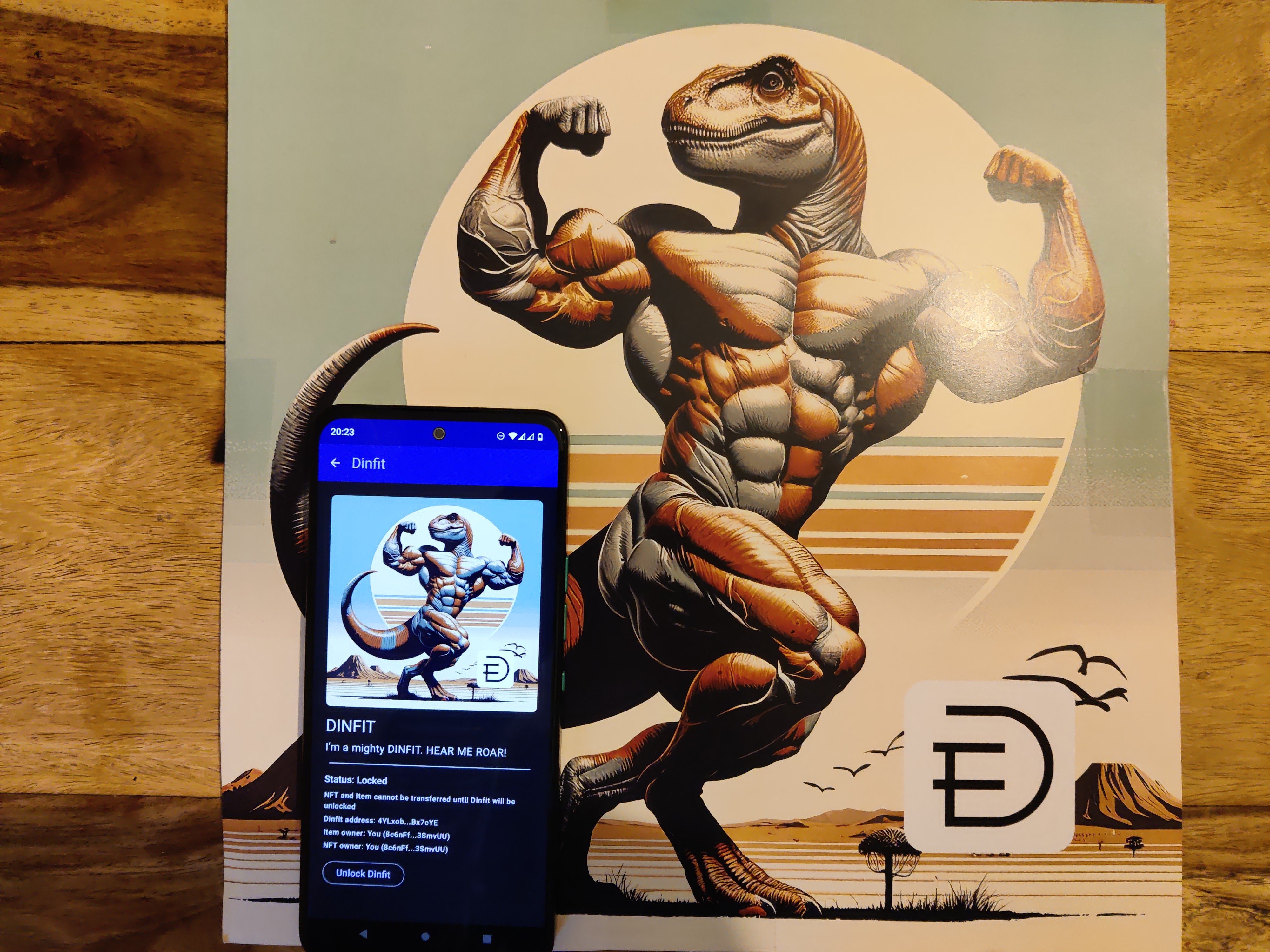
The Future - Today!
For a long time NFTs were limited to pictures stored somewhere in internet. Right-click crowd taunted community with reposting those images like no tomorrow. With the introduction of DINFIT, you not only gain a unique picture of your item but also receive proof of ownership, authenticity, and access to the full capabilities of the blockchain ecosystem for trading and exchanging NFTs. Furthermore, DINFIT offers a protocol for seller and buyer protection.
How it works?
The chip
Every DINFIT is equipped with secure NFC chip that holds a private key associated with this item. These chips, akin to those used by banks for credit cards and governments for IDs, are enhanced with a specialized applet customized for DINFIT requirements. Most DINFIT transactions require signatures of holder of an item and chip.
The NFT
On-chain part of DINFIT is a regular Solana NFT that can be traded or exchanged like any other. However, unlike typical NFTs, a DINFIT token can be claimed to initiate the delivery of the associated physical item to a new owner. Once claimed, the NFT becomes non-transferable until the delivery is completed or the deal is mutually cancelled by both parties.
Item exchange protocol
To protect buyer and seller DINFIT employs escrow scheme for both parties of a deal (not available in DEMO yet). When current owner puts up item to sale (unlocking NFT) they lock funds in special escrow account. Those funds serve as proof of intention to deliver that item and remain locked until deal completes. Similarly, when the current holder of the NFT claims it, they also lock funds in the escrow account as proof of their commitment to completing the transaction. Only after the item arrives at the new owner’s location will both parties execute the ‘close the deal’ action, thereby achieving full ownership of the item and token, and releasing funds from the escrow accounts to both the buyer and the seller.
In-depth explanation
DINFIT state
The story begins with one person owning both the physical item and its corresponding NFT, fully owned and not tradable. Just enjoying life.
When owner decides to put item for sale they initiate the process by unlocking the NFT, simultaneously locking funds into escrow. This transaction is co-signed by chip and verified by on-chain program. From this point, the NFT becomes tradable, and potential buyers can have confidence in the guarantee of delivery, supported by the funds securely locked in escrow.
When NFT is in tradable state it acts as a typical NFT. It can be transferred, listed for sale on a marketplace, and traded indefinitely.
When owner of NFT decides to acquire the item they “claim” NFT locking their portion of funds into escrow account. The seller (holder of the item) and the buyer (holder of the NFT) then negotiate delivery details and may add more funds to their respective escrow accounts.
When the locked funds are equal and terms are negotiated, the seller initiates a ‘start delivery’ transaction, co-signed by the chip and verified on-chain. Following this, the seller ships the item to the buyer’s destination.
Once the item arrives, the buyer initiates a ‘finish delivery’ transaction, co-signed by the chip, and becomes the full owner of DINFIT. Additionally, funds locked into escrow are returned to their respective accounts. With ownership secured, the new owner of DINFIT can now simply enjoy life or choose to start the cycle anew.
Thats whole cycle. Thanks for reading!
Stay in touch
Let’s stay in touch. Newsletter is coming soon. Now you can follow us on X: x.com/team_dinfit